WHOIS Leads — newly registered companies
A daily feed of companies that registered a domain. The most reachable a buyer will ever be, and almost nobody works it.
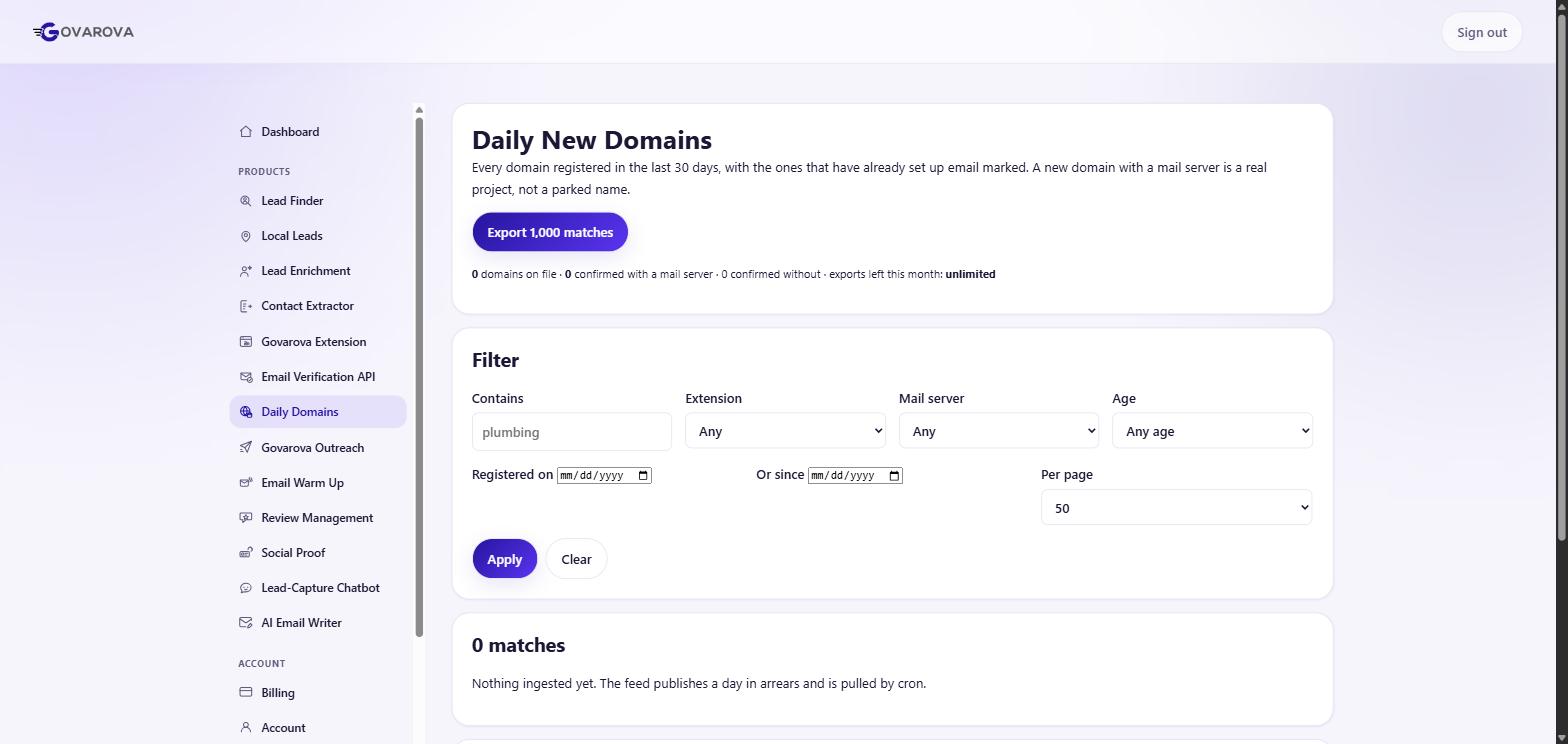
Every day, companies register domains. A company that has just registered a domain has decided to exist — and therefore decided to buy: a website, email, accounting, payments, a CRM.
Why this signal is different
Most intent data is a proxy: somebody visited a comparison page, somebody downloaded a whitepaper. A domain registration is not a proxy. It is an action that costs money and is taken only by someone who has decided to do something. There is no incumbent vendor, no contract, no procurement process, and nobody has sold to them yet.
The catch, stated honestly
The signal-to-noise ratio is dreadful. Most new domains are speculation, defensive registrations, spam infrastructure, or someone's weekend idea. Filtering is the whole job.
The cheapest filter first: does the domain have an MX record? A domain with no mail server is not a business yet. And an MX record appearing on a two-week-old domain is the moment it becomes one — that transition is the buy signal, and it costs one DNS lookup to detect.
What to say to a two-week-old company
Not “congratulations on your new business”. That announces you are watching domain registrations, which is unsettling, and that you have nothing to say, which is worse. The founder is drowning in a list of forty things. Take one off it.
The whole argument is in newly registered domains as a buying signal.
The product behind this
Daily Domains
Get every newly registered domain each day, already matched to founder and company data.
Read next
Data Enrichment — turn a list of companies into contacts
Paste domains or company names; get back verified emails, job titles and firmographics for the people who work there.
Read →Find B2B companies — build the target list first
Search a company database by the attributes that actually predict fit, then enrich the companies you keep.
Read →Find B2C local businesses
Plumbers, dentists, restaurants. A different segment with different rules — and free-mail addresses are not a data-quality problem here.
Read →